

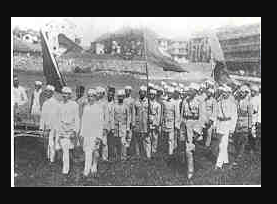
The Khilafat Movement, also known as the Indian Muslim Movement (1919–1924), was a pan-Islamist political protest campaign led by Shaukat Ali, Mohammad Ali Jawaharlal and Abul Kalam Azad led by Muslims in British India to restore the Islamic Caliphate. Whereas one of the Ottoman Caliphate who was considered the effective political authority as the leader of the Sunni Muslims. It was a protest against the embargo imposed on the Caliphate and the Ottoman Empire after World War I by the Treaty of Sèvres.

The movement collapsed in late 1922 when Turkey gained a more favorable diplomatic position and moved towards secularism. By 1924, Türkiye had simply abolished the role of the caliph.
Background
Ottoman Sultan Abdul Hamid II (1876–1909) launched his pan-Islamist program to protect the Ottoman Empire from Western invasion and disintegration and to defeat Western domestic democratic opposition at home. He sent an ambassador named Jamaluddin Afghani to India at the end of the 19th century. The cause of the Ottoman king created religious passion and sympathy among the Indian Muslims. As Caliph, the Ottoman Sultan was the supreme religious and political leader of all Sunni Muslims around the world.
A large number of Muslim religious leaders started working for the Caliphate to raise awareness among Muslims and develop Muslims. Muslim religious leader Maulana Mehmud Hasan tried to organize a national independence war against the British with the support of the Ottoman Empire.
Abdul Hamid II was forced by the Young Turk Revolution to restore the constitutional monarchy, ushering in the Second Constitutional Era. He was succeeded by his brother Muhammad VI (1844–1918), but after the revolution, real power in the Ottoman Empire fell to the nationalists. The movement was an issue at the London Conference (February 1929); But nationalist Arabs see it as a threat to the continued Islamic hegemony of Arab countries.
Division
During World War I, the Ottoman Empire allied with the Central Powers and faced a massive military defeat. The Treaty of Versailles (1919) reduced its territorial limits and reduced its political influence, but the victorious European powers promised to preserve the Ottoman sultan’s status as caliph. However, under the Treaty of Savres (1920), territories like Palestine, Syria, Lebanon, Iraq, Egypt were separated from the empire.
A progressive, secular nationalist movement began within Turkey, known as the Turkish National Movement. During the Turkish War of Independence (1919–1923), Turkish revolutionaries led by Mustafa Kemal Atatkar abrogated the Treaty of Savres with the Treaty of Lausanne (1923). Under Atatkar’s reforms, the Republic of Turkey abolished the Caliphate in 1924 and transferred its power within Turkey to the Grand National Assembly of Turkey.
Although negotiating with the British and continuing their activities, as the Khilafat movement weakened, Muslims were divided between those who favored working for the Congress, those who favored the Khilafat, and the Muslim League.
When the final blow came, Mustafa Kamal’s army was victorious. Mustafa Kemal who overthrew Ottoman rule to establish a progressive, secular republic in independent Turkey. He discarded the role of Khalifa and did not seek any help from the Indians.
The Caliphate leadership fragmented along different political lines. Syed Ata Ullah Shah Bukhari Chowdhury formed Ahrar-e-Islam in the Majlis with the support of Chowdhury Afzal Haque. Leaders like Dr. Ansari, Maulana Azad and Hakeem Ajmal Khan were staunch supporters of Gandhi and the Congress. The Ali brothers joined the Muslim League. They would play a major role in the popular appeal of the League and the subsequent growth of the Pakistan Movement. Yet the Caliphate Conference was held in Jerusalem in 1913 after the abolition of the Caliphate in Turkey to decide what should be done about the Caliphate. The people of villages like Ajla Khurd were the main reason for this.
